

%20(2).png)

The Psychology Behind Outdoor Play: Why It’s So Good for Children

SERIES NOTE
This article is part of a 3-part Curious Roots Collective series exploring the psychology of outdoor play and why it matters so deeply for children (and the adults who care for them)
Exploring the Psychology Behind Outdoor Play for Young Children
I recall a moment a while ago when my son stood at the edge of a small slope.Nothing dramatic. Just uneven ground, loose stones, and a pause that lasted longer than I expected.
“I can’t,” he said.
He tried. He slipped. He frowned. Then, slowly, he adjusted his footing, leaned forward, and climbed.
At the top, he didn’t celebrate.He just stood there, calm and settled, as if something inside had clicked into place.
Watching him, I realised something essential about outdoor play for children:
Outdoor play works not because it’s exciting - but because it asks just enough of them.
When we look at the psychology behind outdoor play, we start to understand why children thrive on gentle challenge and real-world exploration. This small, ordinary moment revealed something far bigger about how children grow, learn, and feel grounded in the world.

Our Brains Are Wired for Gentle Challenge
Modern life is designed to be smooth and predictable.Screens reward instantly. Toys often do the “doing” for us.
But children, like adults, benefit from effortful engagement: activities that require small adjustments, persistence, and real-world feedback.
Outdoor play naturally introduces gentle challenge:
uneven surfaces
shifting textures
weather
open-ended problems
Children must adapt.Try again.Figure things out.
Outdoor play feels good because it’s slightly demanding. it helps children build the confidence that comes from doing something that isn’t immediately easy.
The Emotional Arc of Outdoor Play
Parents often step in when play looks frustrating.But frustration isn’t a failure - it’s a phase.
Researchers studying wellbeing in childhood describe a familiar emotional journey in outdoor play:
hesitation
curiosity
frustration
adjustment
absorption
calm confidence
This journey teaches emotional regulation in the most natural way possible.
Children don’t need to be pushed, they simply need space to move through each stage at their own pace.
Flow Happens in Simple, Natural Moments
Flow state: deep engagement - doesn’t only happen in extreme sports or dramatic situations. Children enter flow easily when the conditions are right.
Flow occurs when play is:
open-ended
free from pressure
sensory-rich
self-directed
minimally interrupted
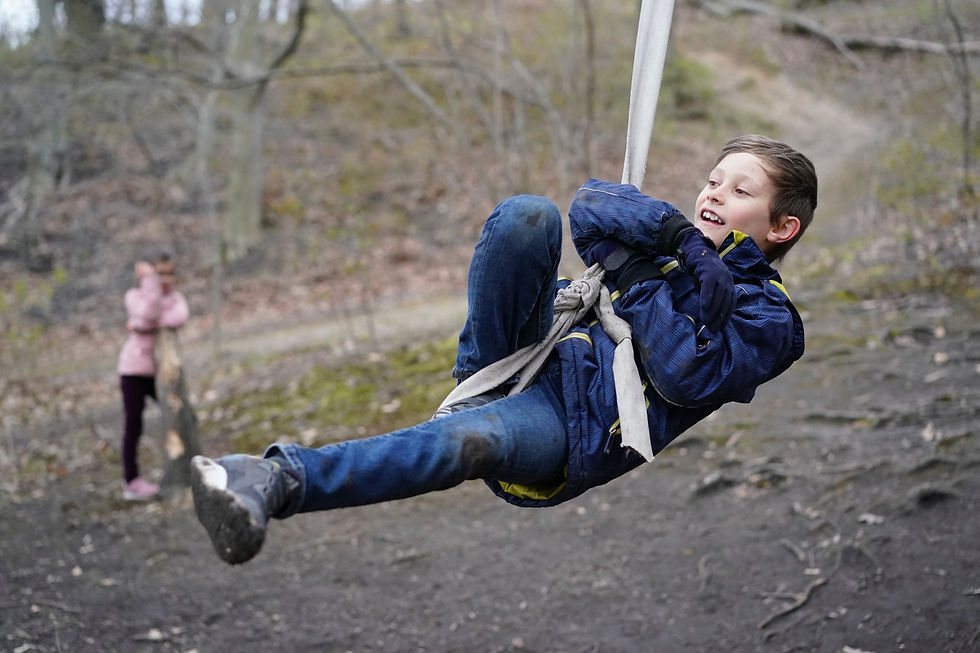
A child collecting stones, inventing a nature game, or balancing on a log can be in just as profound a flow state as an athlete on a mountain.
This state brings:
emotional calm
deep focus
a sense of belonging
fewer intrusive thoughts
Outdoor play gives children the rare gift of unfragmented attention.
Why Nature Calms the Busy Mind
Nature doesn't shout. It doesn’t flash or overload.
It gently invites attention.
Children notice:
the crunch under their feet
the changing light
birdsong
wind
the feel of bark
This type of sensory integration supports emotional regulation and helps children settle, especially those who feel overstimulated or cautious.
And often, something unexpected happens:
Watching a child become absorbed in nature often calms us too.

Where Curious Roots Collective Fits In
Curious Roots Collective was created to make outdoor play easy and accessible for real-life families, not just outdoorsy ones.
Our digital outdoor play packs are:
low-prep
no-pressure
screen-light
flexible (work outdoors or indoors)
perfect for parents, grandparents, educators
They gently guide children into noticing, wondering, exploring, and engaging, without forcing outcomes or needing lots of energy from adults.
If you’d like simple ways to spark outdoor play without prep or planning, explore our Curious Roots Collective Play Packs: nature-inspired activities designed for ages 3–7 and for real families with real lives.
Outdoor Play Isn’t an Extra - It’s Human
Psychologists increasingly suggest that engaging with the natural world through our senses is a basic human need, not an upgrade or lifestyle bonus.
Children don’t need heroics.They don’t need perfect woodland settings.They don’t need constant enthusiasm from adults.
They simply need small, repeatable opportunities to meet the world as it is, and discover that they belong in it.
And often, those moments happen in the simplest places:a garden, a pavement, a courtyard, a park corner, or just outside the front door.


Comments